
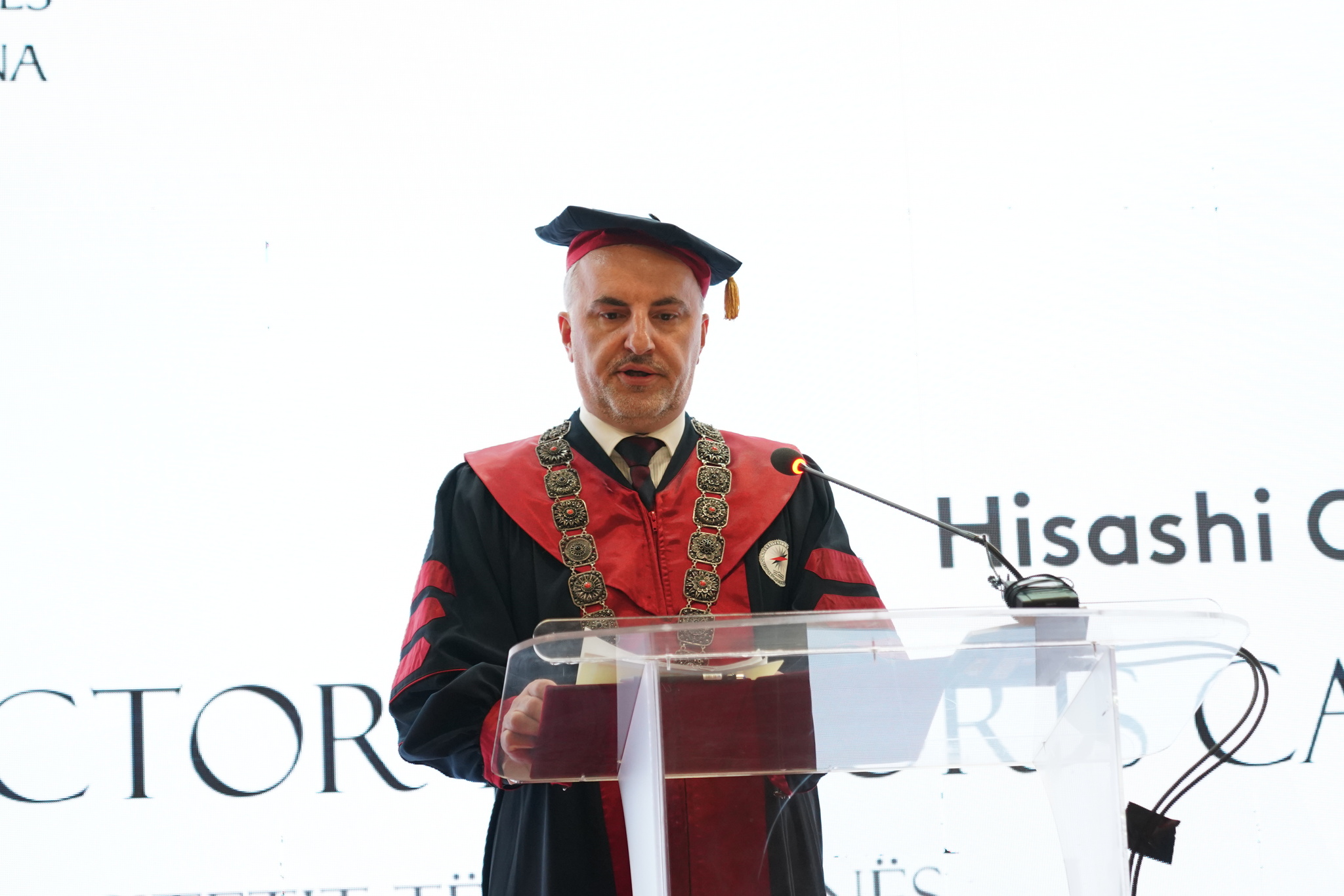
Remarks by the Rector of the University of Prishtina, Professor Arben Hajrullahu, on the occasion of awarding Professor Hisashi Owada the title Doctor Honoris Causa
Your Excellency, Professor Hisashi Owada,
Your Excellency, Ambassador Mr. Kiminori Iwama, and Mr. Hiroyasu Tanigaki, representative of the Embassy of Japan,
Your Excellency, Ambassador Mr. Sabri Kiçmari,
Distinguished members of the national, and international, diplomatic corps present here today,
Esteemed members of the University’s Governing Council, Vice Rectors, Deans, Senators, Professors, and Students of the University of Prishtina,
Ladies and Gentlemen, distinguished attendees,
Professor Hisashi Owada, welcome! (Irasshaimase – いらっしゃいませ) from Nippon, “the Land of the Rising Sun,” known today as Japan, to the land of ancient Dardania, known today as Kosovo.
In the tradition and culture of our people, our home belongs to God, but also to the guest. So, as a guest of the University of Prishtina, please consider yourself at home.
Today, we mark a moment of great pride for the University of Prishtina, for the academic community of the Republic of Kosovo, and beyond.
We are gathered here to present one of the highest honors awarded by the University of Prishtina, the title of Doctor Honoris Causa, to Professor Hisashi Owada — a scholar, judge, and diplomat of global stature. Professor Owada is not only a distinguished academic, but also a true global citizen — an individual who embodies universal values of justice, dignity, and the advancement and protection of international law and human rights.
As a deeply reflective scholar and a globally respected jurist, Professor Owada has profoundly bridged theory with practice. His life and work affirm that the principles of law and legal certainty are not abstract ideals, but guidance for fair governance, peace, and global cooperation.
The global academic and juridical communities continue to draw inspiration from Professor Hisashi Owada’s work. Thanks to him, countless young people around the world — including our own students here — are inspired to pursue justice and dedicate themselves to legal scholarship, envisioning a world with greater fairness, predictability, legal security, and peace.
It is an extraordinary honor for me, as Rector of the University of Prishtina, to welcome such an eminent figure in international law — like Professor Hisashi Owada — who has placed knowledge, integrity, and deep human sensitivity in the service of global peace and justice.
Your Excellency, Professor Hisashi Owada, distinguished guests, allow me to take this opportunity to offer a few reflections on some of the defining developments of the time we are living in, about international law and human security amid technological developments and geopolitics.
The foundations of global and human security rest on international relations and a legal order rooted in rules and predictability. Yet, all major global developments in this third decade of the XXI century suggest that the norms and foreseeability offered by international law are under greater threat than at almost any other time in recent memory. Increasingly, both academic and policymaking circles speak not only of the unraveling of the United Nations based international order but also of a potential transformation of the global system as we have known it since the Peace of Westphalia.
Nevertheless, in the ongoing pursuit of human development, peace, and security, universities — as always — cannot and must not remain indifferent to the present challenges.
In today’s complex world — an age of artificial intelligence and seemingly limitless human capabilities — the traditional schools of thought in international relations, such as Realism, Liberalism, and Constructivism, are no longer sufficient to fully explain or predict developments in international law and security. These shifts directly or indirectly also shape the fate and future not only of nations but of humanity as a whole in our planet.
Despite the prominence of contested issues in contemporary international law — particularly those concerning the meaning and validity of concepts like “self-determination” and “territorial integrity” — the more fundamental question, in my view, remains: Why the state? Why the nation-state?
At a time of major global transformations, like those we are experiencing today, when the UN Charter and the principle of non-intervention seem increasingly optional, if not entirely sidelined, a fundamental question becomes ever more crucial: What should be the true priority, and who serves whom? Is the state for the people, or are the people for the state?
Amid these complex questions, institutions such as the International Court of Justice (ICJ) have, time and again, shown the ability to approach deeply political matters with a profound sense of legal responsibility and rational judgment. The ICJ’s 2010 Advisory Opinion, which affirmed that Kosovo’s declaration of independence did not violate international law, remains one of the most significant milestones in Kosovo’s modern history. They reaffirmed for the people of Kosovo that our pursuit of freedom, independence, and democracy was not merely a political choice, but a moral imperative, an ethical landmark that will remain imprinted in our historical memory. It reflected the values upon which our state was built: equality, citizenship, inclusivity, and peace.
As Rector of the University of Prishtina, but also as a citizen of this country, allow me to emphasize that I have always personally been committed to building lasting peace among people within the Western Balkans and beyond. I deeply believe that sustainable peace is not merely the absence of violence, but the genuine recognition of each-other as equal co-citizens within a democratic political community. This is the ideal of civic statehood that we earnestly aspire to and continue to work for with integrity, courage, and intellectual dedication.
Nonetheless, despite these human efforts, the United Nations Sustainable Development Goals and the concept of Human Security often remain just noble aspirations, much like Immanuel Kant’s vision of “perpetual peace” more than 230 years ago.
Distinguished Professor Hisashi Owada, esteemed guests, allow me to conclude by highlighting the deep and mutual respect that binds Kosovo and Japan. The Japanese people are greatly admired in Kosovo for their resilience, commitment to tradition, and leadership in innovation.
The friendship between Kosovo and Nippon is a bridge built on shared respect, cultural appreciation, and a common dedication to peace and education.
Professor Owada, by accepting this honorary title today, you become a permanent part of our academic legacy. While none of us are eternal, your impact on education, law, and diplomacy will surely endure across generations.
We are deeply grateful for your integrity and the breadth of your contributions. You are, and will remain, a meaningful part of the story of a small nation but with a great spirit and deep gratitude. With this honor bestowed today by the University of Prishtina, you are not only a friend of our academic community but also a distinguished figure enshrined in the historical memory of a nation that stood tall even when justice was absent.
Thank you for coming to the University of Prishtina and to the Republic of Kosovo. We are honored by your presence here today. It is our sincere pleasure to extend to you a warm and heartfelt welcome to the University of Prishtina, your second home, today and always.